
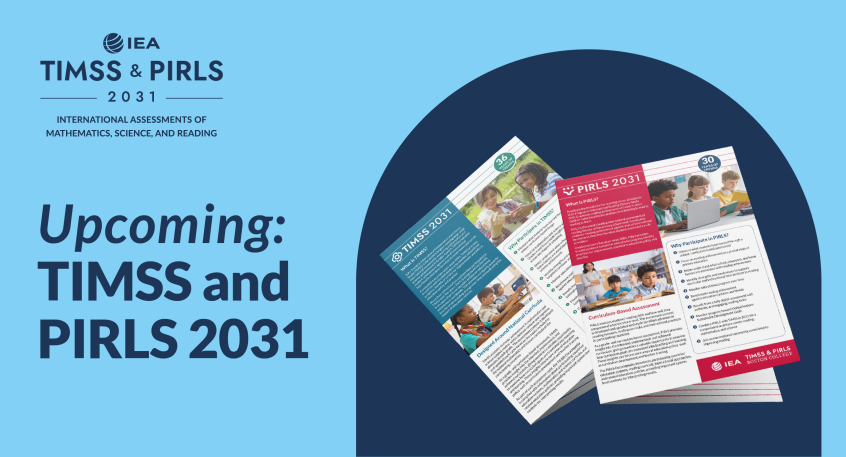
The next cycles of TIMSS (Trends in International Mathematics and Science Study) and PIRLS (Progress in International Reading and Literacy Study) will be conducted in parallel in 2031, offering countries a unique opportunity to participate in both studies in the same year. Boston College highlighted the upcoming cycles during a session at the 67th IEA General Assembly, where participants learned more about what is planned for 2031.
A once-in-a-generation opportunity
The alignment of TIMSS and PIRLS occurs only once every 20 years. After 2031, the next opportunity to assess the same students' reading, mathematics, and science achievement within a single school year will not come until 2051.
For countries participating in both studies, TIMSS and PIRLS 2031 will provide a more integrated picture of student achievement across key areas of the primary school curriculum. Rather than examining reading, mathematics, and science performance separately, the combined data will allow researchers to explore relationships between achievement across these domains.
Matthias von Davier, Executive Director, TIMSS & PIRLS International Study Centre, states:
“The database will be one of the most comprehensive international resources for understanding the interconnected factors shaping student achievement across the primary school curriculum.”
Both studies are conducted by the TIMSS & PIRLS International Study Center at Boston College for IEA, in collaboration with IEA offices and research partners. Their shared institutional and methodological foundation allows for coordinated planning and implementation, helping to streamline participation for countries taking part in both studies.
How TIMSS and PIRLS make a difference
Participation in TIMSS and PIRLS helps education systems identify strengths and weaknesses, better understand factors associated with student achievement, and inform curricular and instructional interventions. The studies also enable countries to monitor educational progress over time and benchmark achievement against education systems worldwide.
The National Center for Human Resources Development in Jordan states:
“As a direct result of participation in PIRLS, committees have been formed to revise the Arabic language curriculum in Jordan. PIRLS has also played a vital role in the development of the Education Reform for Education Strategic Plan 2018–2022 and the National Strategy for Human Resource Development (2016–2025).”
The Ministry of Education in Singapore states:
“Participating in TIMSS has provided Singapore with insights, as well as valuable benchmarking and trend information, not just about student knowledge and skills in mathematics and science, but also, about other important developmental outcomes, such as students’ attitudes toward learning the subjects and their social and emotional well-being in school.”
Learn More About TIMSS and PIRLS 2031
For more information about each study and an overview of what’s ahead, view the TIMSS 2031 brochure and PIRLS 2031 brochure. The information packages for both studies will be available in December 2026.