
Thought-provoking partner perspectives
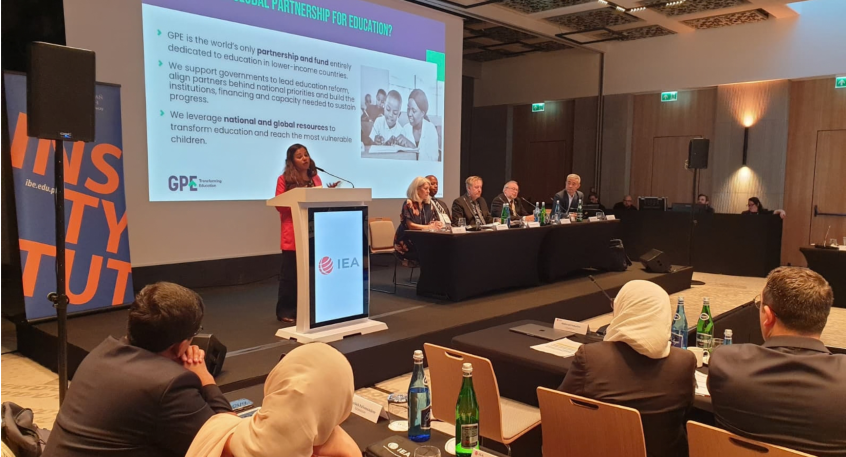
On Tuesday afternoon, IEA General Assembly members engaged with a thought-provoking panel discussion on the challenge of strengthening education quality across low- and middle-income countries. The panel comprised colleagues representing critical stakeholders working to address this educational challenge, providing invaluable insights into how national, regional, and global partners can strengthen assessment ecosystems.
We were honored to welcome Mr. Albert Nsengiyumva from the Association for the Development of Education in Africa (ADEA), Ms. Ramya Vivekanandan from the Global Partnership for Education (GPE) and Dr. Yanhong Zhang from the UNESCO Institute for Statistics (UIS) to the stage, for the session moderated by Dr. Dana Kelly, LaNA Study Director.
The role of assessment and evidence in addressing the challenge of improving teaching and learning in Africa and beyond
Ensuring that all children develop foundational skills in literacy and numeracy remains one of the most pressing challenges facing education systems, particularly across low- and middle-income countries. Reflecting on the critical importance of gathering evidence and data to address the challenge in an African context, Mr. Nsengiyumva explained:
"The demand is real. What has been missing is continuity: countries come in for one study and then drop out of the trend line. The task is to turn episodic participation into a lasting relationship, and to make sure the data is used."
Mr. Nsengiyumva emphasized that assessment alone does not improve learning; its value depends on whether data are relevant to national priorities, accessible to countries and, crucially, translated into policies and actions that improve teaching and learning. In explaining how UIS looks to support countries in transforming data into evidence-informed policy, Dr. Zhang echoed these sentiments. He noted that:
"Learning assessments create lasting value only when the participants own the evidence, and can turn them into real national actions… a country does not just get value from evidence by participating; the evidence must contribute to a national conversation about what should change in how students learn."
Obstacles to progress and the importance of collaboration
The panelists each noted that there are significant obstacles to the improvement of educational quality across low- and middle-income countries today. In sharing the broad context of the work that GPE does with partner countries across more than 90 lower-income countries around the world, Ms. Vivekanandan shared:
"We cannot improve learning outcomes without data on whether and how children are learning. Challenges include the lack of alignment with broader data systems, a plethora of different and ad-hoc assessments that are sometimes fragmented and incoherent, and gaps in funding and capacity."
GA members heard from the three panelists about how partnerships between countries, international organizations, research institutions, donor organizations, and beyond are a necessity for improving education quality in low- and middle-income countries.
The panel inspired discussion about how IEA and its network can contribute to these efforts by expanding access to international assessment, strengthening assessment capacity, and helping countries generate and use evidence to improve children’s learning.
LaNA as a tool for closing the education data gap
IEA’s newest international study Literacy and Numeracy Assessment (LaNA) is one way in which IEA aims to make a difference in this conversation. While many low- and middle-income countries still lack data on what their children are actually learning, LaNA can help close this gap, inform national education policies and build sustainable system capacity. In closing the panel discussion, Dana explained:
"LaNA’s targeted design means education systems can gain meaningful insights into students who are still developing foundational skills, not just those who have reached minimum proficiency. It also tells us how many children have reached higher proficiency levels."
The panel was very warmly received by IEA’s General Assembly members and other observers. We are very thankful for our panelists’ contributions to this incredibly important discussion, striking as the conversation did to the heart of why so many in attendance became involved in education in the first place: to make access to quality education a reality for all children.