
Since the first international IEA studies were conducted over 60 years ago, international large-scale assessments (ILSAs) in education have become a vital source of data for informing education policy by evidence around the world. Participation levels in these studies have grown, the studies have evolved over time, and ILSAs have accordingly had a huge impact on the global education landscape.
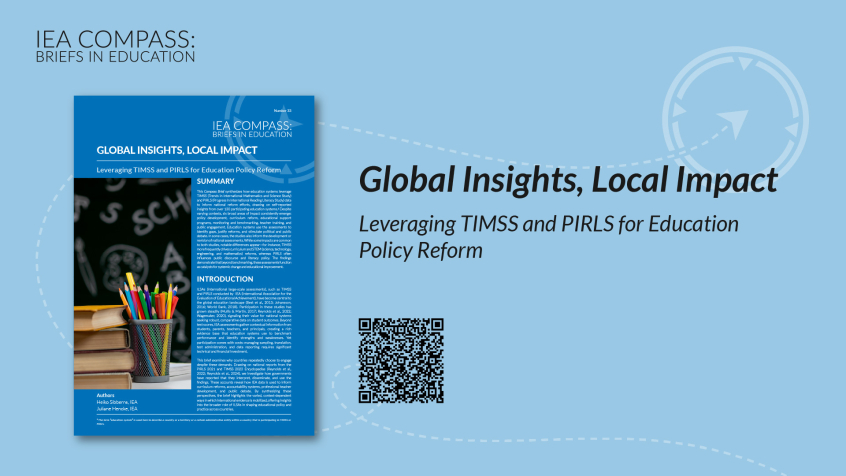
The newest edition to the IEA Compass: Briefs in Education series— ‘Global Insights, Local Impact: Leveraging TIMSS and PIRLS for Education Policy Reform’—looks to explore how two of IEA’s flagship studies are being used to shape national reform efforts, drawing on self-reported insights from over 130 participating education systems.
One of the brief’s co-authors, Juliane Hencke (Director IEA Hamburg), while preparing to speak last year at an event on the impact of IEA studies, wondered whether the topic should be examined more systematically. She explained:
“‘I thought: ‘We know a great deal about how our studies are conducted and what data they deliver, but what do the countries actually do with those data afterwards? And why do they choose to participate in our studies time and again?’ This line of thinking led my co-author Heiko Sibberns and me to the idea of taking a closer look at the country reports from the TIMSS and PIRLS encyclopedias, and finally to the production of this new Compass Brief”
‘Global Insights, Local Impact: Leveraging TIMSS and PIRLS for Education Policy Reform’ is a fascinating exploration of the most recent editions of the TIMSS and PIRLS encyclopedias, and it captures how education systems reported using international assessment data across 17 different thematic areas.
What percentage of education systems reported using TIMSS and PIRLS data to help develop or improve teaching materials? What percentage of education systems reported using TIMSS and PIRLS data to review or revise curricula? Read the new Compass Brief to find these answers, and much more: https://www.iea.nl/publications/series-journals/iea-compass-briefs-education-series/october-2026-global-insights-local-impact
What are the TIMSS and PIRLS encyclopedias?
Every cycle of both TIMSS (Trends in International Mathematics and Science Study) and PIRLS (Progress in International Reading Literacy Study) involves the publication of an encyclopedia. The encyclopedias present profiles of the national contexts shaping education in each of the education systems that participate. Experts from participating education systems are asked to summarize how results from the studies are used, and to describe how they have impacted national education policies.