
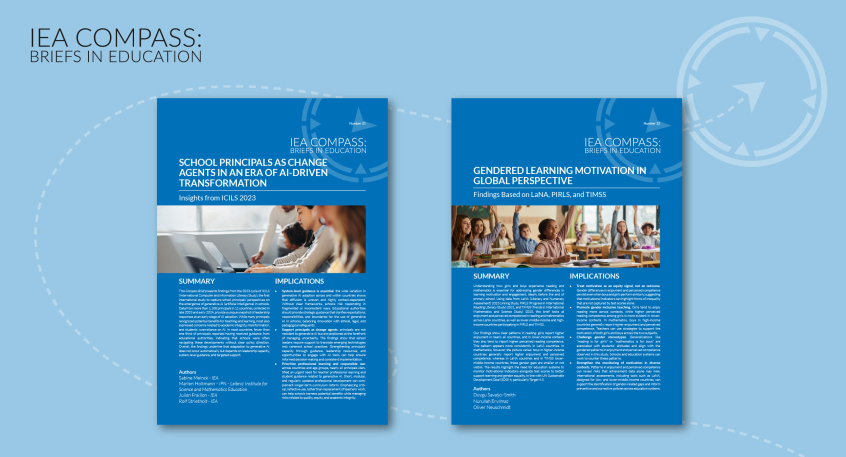
IEA is proud to present two new additions to our IEA Compass: Briefs in Education series:
Information collected on contexts for learning is a vital part of the data of large-scale assessments in education. More than simply assessing students’ levels of academic achievement, IEA’s research aims to develop an understanding of the factors that affect learning at home and in school. The new Compass Briefs make use of questionnaire data to investigate two highly relevant topics for education policy around the world today:
- School leadership perspectives on the emergence of generative AI in schools
- How learning motivation and self-efficacy varies for boys and girls in education systems at different income levels
Speaking on the importance of the Compass Briefs series and the two new additions, series editor Dr. David Rutkowski, Associate Professor at Indiana University, notes:
"What I value most about the Compass Brief series is that it provides a space for researchers to take important findings and ask what they mean for education policy and practice. That connection is not always straightforward, and it requires both strong research and careful communication. These two new briefs are excellent examples of what the series is intended to accomplish. Their publication is an important achievement for the authors and contributes to IEA’s broader effort to ensure that evidence from international assessments informs meaningful conversations about education."
These latest IEA Compass: Briefs in Education are released this week to coincide with the annual Association for Educational Assessment in Africa (AEAA), held in Arusha, Tanzania, and the European Conference on Educational Research (ECER) for 2026, held in Tampere, Finland.
AI in schools: Insights from ICILS 2023
"ICILS 2023 remains the first and, to date, only international study to provide cross-nationally comparable, representative data on principals’ perspectives on generative AI."
ChatGPT was released to the general public in November 2022, precipitating a rapid proliferation of generative AI usage across society, including in schools. At that time, preparations were in the final stages for the data collection for ICILS 2023, set to begin only a few months later. Being responsive to the seismic change AI was set to have on schools and ICT, ICILS 2023 adapted to include a set of questions on AI, administered to school principals in 11 participating countries.
School principals, as organizational leaders, have huge influence on the adoption of technology in schools, and play a critical role in how and if AI is integrated into school practice around the world. Compass Brief 31, School Principals as Change Agents in an Era of AI-driven Transformation: Insights from ICILS 2023, makes use of the ideally timed ICILS 2023 school principal AI data collection to offer insights into early patterns of awareness, adoption, and concern about the use of AI in schools.
Gender differences in learning motivation: Insights from LaNA, PIRLS and TIMSS
"Tracking students’ enjoyment and confidence through national and international monitoring systems, including assessments like LaNA, can support countries in identifying gender gaps and designing policies that advance progress toward SDG 4"
Gender differences in self-confidence and in enjoyment of mathematics and reading have long been a topic of interest in large-scale assessments of education. However, these data have mostly been drawn from high-income countries until recently. The LaNA 2023 Linking Study collected data from six low- and lower-middle-income countries (LLMICs)—Burkina Faso, Egypt, Nigeria, Pakistan, Palestinian and Senegal—and as the assessment was linked to TIMSS and PIRLS, it allows for comparison between LaNA countries and a broader set of education systems at different income levels.
Compass Brief 32, Gendered Learning Motivation in Global Perspective: Findings Based on LaNA, PIRLS, and TIMSS, investigates how gender patterns in enjoyment and self-efficacy in LLMICs compare with those in other income categories, and considers how gender differences in enjoyment and perceived competence can be explained by differences in achievement.